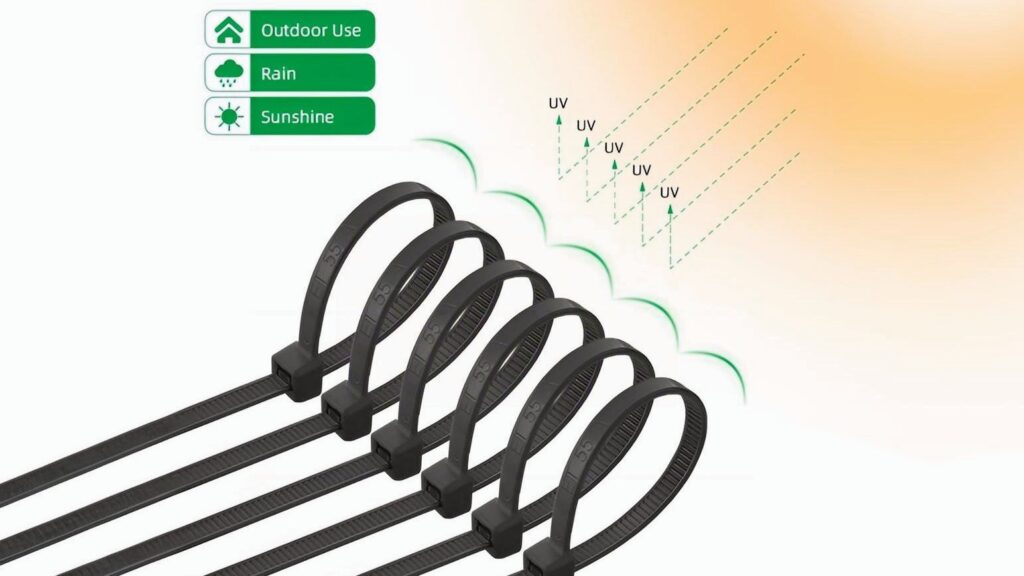
PA66 UV-Resistant Grade, also referred to as UV-stabilized Nylon 66, is a specialized material formulation developed to withstand prolonged exposure to sunlight, UV radiation, ozone, and outdoor weathering. Compared to standard PA66, UV-resistant grades maintain tensile strength and dimensional stability for a longer service life in outdoor and solar applications such as photovoltaic cable management, telecom installations, and construction wiring.
This makes PA66 UV-Resistant Grade one of the dominant materials used in black outdoor cable ties and related fastening components across industrial and electrical sectors.
Table of Contents
ToggleHow UV Stabilization Works
PA66 is inherently strong, heat-resistant, and chemically stable, but standard unmodified nylon degrades under UV radiation due to polymer chain scission. Stabilization is typically achieved through:
✔ Carbon Black (CB) Loading — Carbon black absorbs UV radiation and prevents polymer degradation. Industrial black cable ties usually rely on this mechanism.
✔ UV Absorber Additives — For applications requiring lighter colors or specific performance, HALS (Hindered Amine Light Stabilizers) or UV absorbers may be used.
The carbon black variant is considered the industry standard for long-term outdoor durability due to its stability and cost-efficiency.
Performance Characteristics
Key characteristics of PA66 UV-resistant grade include:
• UV Durability
Maintains structural and mechanical integrity under sunlight exposure for 5–10 years, depending on geography and installation environment.
• Mechanical Strength
Retains high tensile strength and modulus essential for cable bundling and mounting.
• Thermal Resistance
Suitable for high-temperature environments commonly found around power distribution and solar systems (continuous service up to ~80–120 °C depending on formulation).
• Chemical Resistance
Resistant to oils, fuels, and industrial chemicals — advantageous in outdoor and automotive usage.
• Weathering Stability
Endures cycles of heat, cold, moisture, and wind loading without significant brittleness.
Relevant Standards & Testing
For engineering and qualification purposes, the following standards are commonly referenced:
✔ ISO 4892 Series – Accelerated UV weathering test
✔ ASTM G154 / G155 – Fluorescent/Arc UV test methods
✔ SAE J1960 – Automotive UV weathering test
✔ UL 62275 Type 2/21 – Outdoor and solar cable management
✔ UL 94 – Flame rating (often V2 for black cable ties)
✔ RoHS / REACH – Environmental compliance
Manufacturers and EPC integrators in the solar and electrical sectors increasingly require UL 62275 due to its relevance in PV cable routing and mounting reliability.
Application Scenarios
PA66 UV-resistant grade is widely used across outdoor-exposed sectors, including:
Solar & Renewable Energy
PV module cable routing
Inverter cable bundling
Ground-mount racking systems
Tracker & rooftop installations
Solar Cable Ties / UV-Rated Cable Ties
Telecommunication & Utilities
Tower wiring
Fiber routing
Outdoor junction hardware
👉General Purpose Nylon Cable Ties
Construction & Industrial
Outdoor electrical installations
HVAC & piping systems
Temporary job-site fastening
👉 General Purpose Nylon Cable Ties
Automotive Exterior Components
Engine bay harnessing adjacent to firewall
External clips exposed to heat and sun
👉Heat-Resistant Cable Ties
Comparison: Standard PA66 vs. UV-Resistant PA66
| Attribute | Standard PA66 | UV-Resistant PA66 |
|---|---|---|
| UV Exposure | Poor | Excellent |
| Outdoor Use | Limited | Long-term |
| Color | Natural / White | Black (CB) |
| Typical Lifetime | 6–18 months | 5–10 years |
| Applications | Indoor / Electrical | Outdoor / Solar / Telecom |
This comparison helps both distributors and engineers specify appropriate materials based on use environment rather than cost alone.
Material Selection Considerations
When specifying UV-resistant PA66 for cable management products, designers and procurement teams typically evaluate:
✔ Lifetime performance expectations (5 / 10 / 15 years)
✔ Solar / marine / tropical climate exposure
✔ Regulatory standards (UL, RoHS, REACH)
✔ Continuous operating temperature
✔ Color and aesthetic requirements
✔ Chemical exposure profile
If environments involve both UV + high heat, PA66 Heat-Stabilized Grade or Stainless Steel Cable Ties may be recommended as alternatives.