
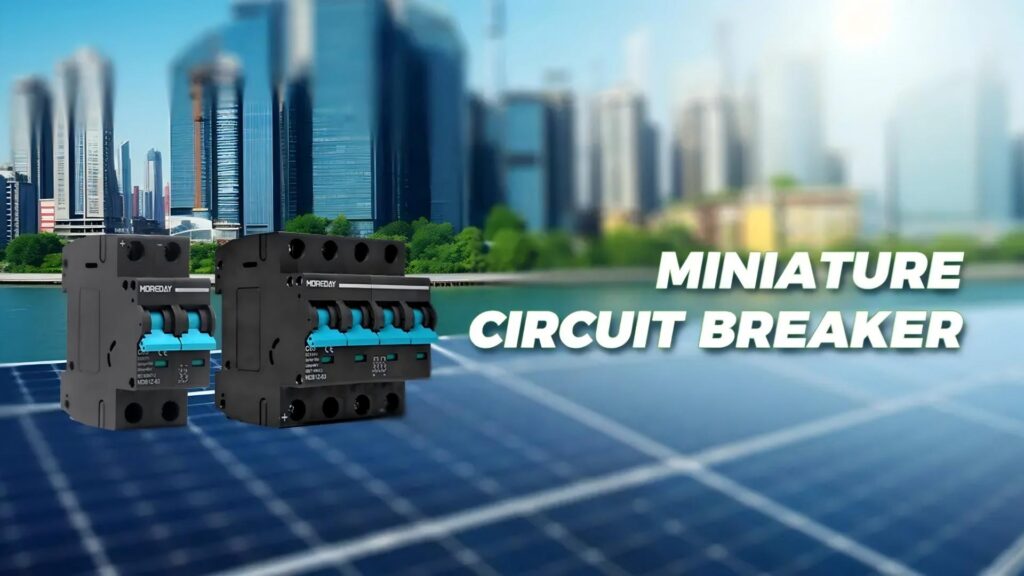
Correctly sizing an MCB (Miniature Circuit Breaker) is a critical step when designing or installing a home photovoltaic (PV) system. An undersized MCB may trip frequently, while an oversized one may fail to provide adequate protection, increasing the risk of cable damage or fire.
This guide explains how to size an MCB for home PV systems, covering basic principles, calculation methods, and key safety considerations to help ensure reliable and compliant system operation.
What Is an MCB and Why Is It Important in PV Systems?
An MCB is a protective device designed to automatically disconnect a circuit in the event of overload or short circuit. In home PV systems, MCBs are commonly used on:
- DC circuits between solar panels and inverter
- AC circuits between inverter and distribution board
- Auxiliary circuits related to monitoring or protection
The main purpose of an MCB is to protect cables and equipment, not the solar panels themselves.
Key Factors That Affect MCB Sizing
When selecting an MCB for a home PV system, several factors must be considered:
- Maximum operating current
- Cable size and current-carrying capacity
- System voltage (DC or AC)
- Type of load and inverter characteristics
- Environmental conditions
Ignoring any of these factors may result in improper protection.
Step 1: Determine the Maximum Circuit Current
The first step in sizing an MCB is calculating the maximum current of the circuit.
For DC Side (PV Array)
The DC current is usually based on the short-circuit current (Isc) of the solar panels.
A common design rule is:
MCB current rating ≥ 1.25 × Isc
This accounts for continuous operation and safety margins under high irradiance conditions.
Example:
If the PV string Isc is 10 A, the minimum MCB rating should be:
- 10 A × 1.25 = 12.5 A → select the next standard size, such as 16 A
For AC Side (Inverter Output)
On the AC side, the current is calculated based on inverter power output.
Formula:
Current (A) = Power (W) ÷ Voltage (V)
Example:
For a 5 kW single-phase inverter at 230 V:
- 5000 ÷ 230 ≈ 21.7 A
Applying a safety margin:
- 21.7 × 1.25 ≈ 27 A → select a 32 A MCB
Step 2: Match the MCB to the Cable Size
The MCB must always protect the cable. This means:
MCB rating ≤ cable current-carrying capacity
If the MCB rating is higher than the cable can safely carry, the cable may overheat before the breaker trips.
Always verify:
- Cable cross-sectional area
- Installation method (conduit, trunking, free air)
- Ambient temperature
Cable selection and MCB sizing must be coordinated.
Step 3: Select the Correct MCB Type and Curve
DC vs AC MCB
- DC MCBs are required for PV array circuits due to higher arc energy in DC systems
- AC MCBs are used on inverter output and grid connection
Never substitute an AC MCB for DC applications unless explicitly rated for DC use.
Tripping Curve (B, C, or D)
For home PV systems:
- Type B: Suitable for resistive loads and general residential circuits
- Type C: Commonly used for inverter outputs due to moderate inrush currents
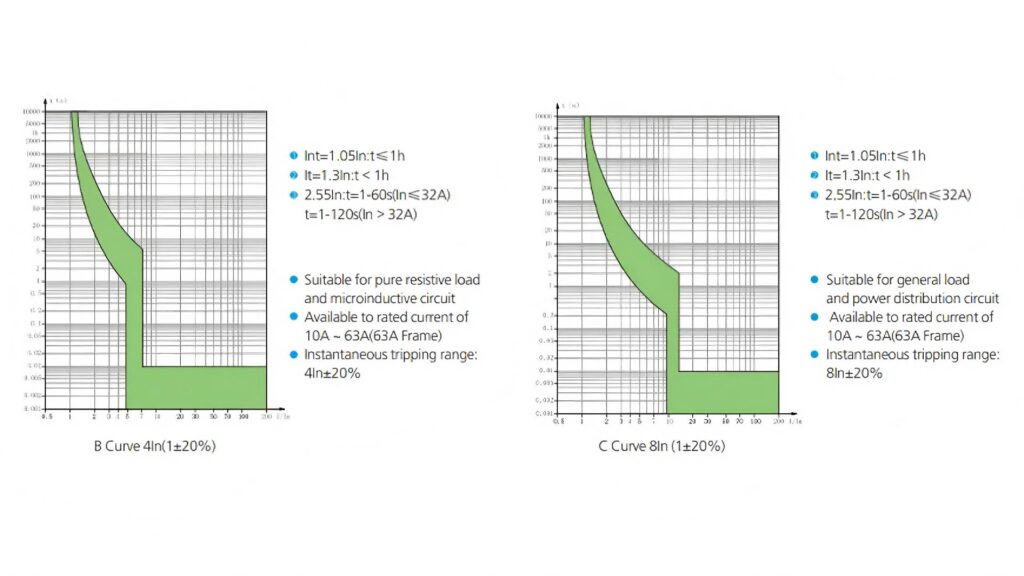
Type C MCBs are often preferred for PV inverters.
Step 4: Consider Voltage Rating and Poles
Ensure the MCB voltage rating meets or exceeds system voltage.
- DC PV strings may require 500 VDC, 600 VDC, or 1000 VDC rated MCBs
- Single-phase AC systems typically use 230 V AC MCBs
- Double-pole MCBs may be required to isolate both live and neutral conductors
Always follow local electrical codes.
Common Mistakes to Avoid
- Using standard AC MCBs on DC PV circuits
- Oversizing MCBs “for safety”
- Ignoring inverter manufacturer recommendations
- Not accounting for temperature derating
- Mixing cable sizes without proper protection
These mistakes can reduce system safety and reliability.
Standards and Compliance Considerations
MCB selection should align with applicable standards, such as:
- IEC 60898 / IEC 60947
- Local electrical installation regulations
- Inverter manufacturer installation manuals
Compliance ensures both safety and easier inspection approval.
Conclusion
Sizing an MCB for a home PV system requires careful consideration of current, cable capacity, voltage rating, and system characteristics. By correctly calculating circuit current, applying appropriate safety margins, and selecting the correct MCB type, homeowners and installers can ensure safe, reliable, and long-lasting PV system performance.
Proper MCB sizing is not just a technical detail—it is a fundamental safety requirement for any home solar installation.